If you run IT operations at a mid-to-large enterprise, ServiceNow is probably already on your stack — or on the short list. The platform owns incident management, change control, and the CMDB for most of the Fortune 500. What ops leaders actually need is a clear map: what ServiceNow does well, where Now Assist and Integration Hub fit, and when cross-tool work needs something beyond in-platform automation.
This guide is for IT and operations leaders — not ServiceNow admins, not developers hunting GlideRecord tutorials. We credit the platform honestly, then name the specific scenarios where teams add governed orchestration on top.
Short version
ServiceNow is the enterprise system of record for ITSM, CSM, and HRSD on a single data model. Now Assist adds generative AI inside the platform. Integration Hub connects adjacent tools. For most operations teams, the open question is when in-platform AI and sync stop short — and cross-system work needs preview, approval, and one audit timeline across your ticket systems, project tools, and chat.
- ServiceNow = enterprise ITSM/CSM/HRSD system of record with workflow automation on one platform
- Now Assist = in-platform generative AI (summaries, drafts, search); metered per contract
- Integration Hub / Spokes = native connectors for mirroring records to external APIs
- The ops question: when sync and in-platform AI are not enough, teams need preview on live downstream queues, approval by risk, and one cross-tool audit timeline
What the ServiceNow tool actually does for operations teams
ServiceNow started as an IT ticketing system in 2004 — “expensive ticketing tool” is still the most common misconception in evaluation meetings. The product outgrew that label years ago.
Today it runs on the Now Platform: a single data model powering ITSM, CSM, HRSD, IT Operations Management (ITOM), and custom workflow apps. Every record lives in the same architecture — one place to see what is open, who owns it, and what changed.
For operations teams, the practical footprint breaks down like this:
- ITSM — incident, problem, change, and service request management; the anchor for most deployments
- CSM — customer case management, portals, and field service
- HRSD — employee service delivery for HR workflows
- CMDB — configuration management database tracking IT assets and their relationships
- Flow Designer — no-code workflow automation inside the platform
Fortune 500 deployments commonly span ITSM, ITOM, HRSD, CSM, Field Service Management (FSM), and Strategic Portfolio Management (SPM). Mid-market buyers often land on ITSM and CSM only. SI practitioners report typical go-live timelines of 2–3 months for smaller accounts and 6–8+ months for enterprise rollouts.
ServiceNow reports 8,800 customers, including about 85% of the Fortune 500 (Q4 2025). For enterprises that need one system of record for IT operations, with audit trails and ITIL-aligned workflows baked in, the platform keeps winning enterprise evaluations.
If your team already runs ServiceNow, you are not evaluating whether it works. You are evaluating what to add when work crosses the platform’s edge.
Core terminology
- Now Platform
- The foundational architecture for all ServiceNow applications. One data model, one workflow engine, one set of admin controls — shared across ITSM, CSM, HRSD, and custom apps.
- ITSM
- IT Service Management — the core suite for managing IT services, incident lifecycles, change control, and service catalogs. The starting point for most enterprise deployments.
- Integration Hub
- ServiceNow's native integration framework for connecting the platform to external APIs. Uses pre-built Spokes (connectors) and custom REST integrations via MID Server.
- Now Assist
- The generative AI layer embedded across ServiceNow. Drafts resolution notes, summarizes incidents, generates knowledge articles, and powers AI Search — all inside existing workflows.
- CMDB
- Configuration Management Database — the central repository for IT infrastructure data and the relationships between assets, services, and configuration items. Acts as the system of record for IT assets.
ServiceNow ITSM beyond the standard ticketing system
ITSM is where most enterprises land first — and where the “ticketing system” label still has partial truth. Incidents, problems, changes, and service requests are tickets. But ITSM on the Now Platform is a workflow engine, not a queue with a subject line.
The core modules most ops teams run:
- Incident Management — log, classify, assign, and resolve unplanned interruptions
- Problem Management — root-cause analysis and permanent fixes for recurring incidents
- Change Management — controlled rollout of IT changes with approval workflows and risk assessment
- Service Catalog — self-service portal where employees request laptops, software access, or VPN setup
- Knowledge Management — articles and runbooks that deflect tickets before they reach an agent
The shift from manual support to automated self-service is the biggest operational win ITSM delivers. Employee portals with AI Search and Virtual Agent let people resolve common issues without opening a ticket.
Practitioners note Virtual Agent often underwhelms out of the box — the teams that earn high deflection rates invest heavily in knowledge-base hygiene first. Budget for content, not just licenses. In SI interviews, the work practitioners cite as most manual is not ticket logging — it is Performance Analytics: reports, dashboards, and the KPI logic that stakeholders actually want. That module’s proprietary constraints and slow UI make tuning analytics a standing ops tax.
ITSM is the anchor because it is where volume, visibility, and governance converge — and where most ServiceNow AI investments start.
Upgrade and maintenance reality
ServiceNow’s depth is an asset until your instance ages. The platform mandates upgrades every six months. Each enterprise cycle often includes a 2–3 week production code freeze while changes are validated and promoted.
A 10-year-old instance can surface 2,000–3,000 skipped records per upgrade — conflicts between custom code and new out-of-the-box features. Each record takes 15 minutes to two hours to resolve manually. Upgrade and cloning work can consume the bulk of managed-service hours; some customers delay upgrades up to two years until ServiceNow forces a support cutoff. “Back-to-box” migration projects for over-customized estates commonly land as seven-figure SOWs.
None of this diminishes the platform’s fit as an ITSM system of record. It does mean ops leaders should budget maintenance as a recurring line item — not a one-time implementation cost.
What is Now Assist?
Now Assist is ServiceNow’s generative AI layer: it drafts text, summarizes records, and powers AI Search inside ServiceNow, on live data, without switching to an external chatbot.
Generative AI skills vs. agentic AI. Now Assist provides skills — summarization, resolution-note drafting, knowledge article generation — that assist humans who review the output. ServiceNow AI Agents (Autonomous Workforce, AI Control Tower) go further: triaging cases, running multi-step workflows, and taking autonomous actions. Now Assist makes agents faster; AI Agents act on their own.
Metering and licensing. Now Assist skills are metered and licensed per contract — not unlimited. Finance and ops leads should model expected usage before rolling out broadly.
Practitioners add texture the vendor numbers leave out. Now Assist is subscription-based with per-usage tokens — implementation teams only get access when the client has licensed and paid for it. SI practitioners cite roughly $0.30 per assist; for some accounts, offshore delivery is still cheaper than scaling Now Assist consumption. Some Tier 1 desks see limited out-of-the-box value, and consumption-based “assists” pricing makes costs hard to forecast — CIO notes the assists per interaction vary, so an autonomous agent stuck in a retry loop can quietly run up the bill. Model your usage before you sign. Those gains track data quality: thin knowledge bases and CMDB records produce thin summaries. Now Assist rewards teams that aim it at specific, high-volume workflows.
Now Assist earns its place in a ServiceNow evaluation. The caveat is in the name: it speeds up work inside ServiceNow. It does not reach the tools where the rest of the work lives — and for most operations teams, that is the harder problem.
ServiceNow integrations explained
Most enterprises do not run ServiceNow in isolation. Engineering lives in Jira. Comms runs through Slack. Integration Hub is how ServiceNow connects to that wider stack.
| Integration method | What it is good for | Friction |
|---|---|---|
| Integration Hub + Spokes | Pre-built connectors to common SaaS tools (Jira, Slack, Microsoft Teams, Salesforce). Flow Designer triggers actions on external systems. | Spoke catalog covers major vendors; custom targets need developer time. Learning curve for non-admin builders. |
| REST API / MID Server | Custom integrations to legacy systems, on-prem apps, or anything without a Spoke. Full control over request/response mapping. | Requires API expertise. MID Server adds infrastructure to maintain. Ongoing maintenance as external APIs change. |
| Jira eBonding | Bidirectional sync of incidents and issues between ServiceNow and Jira. Keeps records mirrored across IT and engineering. | Works well for record mirroring. Does not add approval gates or cross-tool audit on agent actions. |
| Flow Designer outbound actions | Trigger external API calls from ServiceNow workflows — update a record, post a message, create a ticket elsewhere. | Powerful but can sprawl. Each flow is a maintenance item. No unified preview across downstream systems. |
Sync and eBonding keep records aligned — an incident in ServiceNow appears as an issue in Jira with linked fields. Valuable for visibility.
Practitioners report a consistent pattern in the field. Jira and Slack ticket mirroring is often the live demo that closes the SOW for mid-market buyers. Fortune 500 estates connect Jira, Confluence or SharePoint, Oracle or NetSuite (often via JDBC), Workday, and UKG depending on the workflow — HR, IT, or field service. Large enterprises track implementation work in their own Jira; partners inherit client tooling rather than imposing their own.
Integration Hub (now under the Workflow Data Fabric umbrella) is expensive even for enterprises. When spoke licensing ran on a per-transaction model, many teams shifted to custom REST integrations instead. GSIs such as Deloitte deploy prepackaged REST patterns in about a week. Spokes can be surface-level — a Workday spoke may expose only two API methods, forcing a custom build for anything beyond basic sync.
The distinction ops teams miss: sync mirrors data; governed orchestration adds preview, approval, and one audit timeline across tools. Integration Hub moves records. It does not show what an agent would write to a live Jira epic before it writes, route that action through approval by risk, or produce one run-level record spanning both systems.
That gap is structural. At Team ‘26, specialists described IT-to-engineering handoffs still done by hand — “a person on each side acting as the human middleware” — because sync copied the record, not the decision trail. Plan for integration ops as a line item: steep learning curve and ongoing maintenance as APIs evolve.
See the ServiceNow integration page and Jira integration page for what Hookshot supports natively.
The governance gap: where ServiceNow fits and where teams add orchestration
Inside its own walls, ServiceNow is hard to beat. Flow Designer runs in-platform workflows, Now Assist speeds up agent work on live records, and platform logging gives compliance a clean answer to who changed what and when.
Handoffs are where it gets thin. When work leaves ServiceNow for another team’s tool — an engineer’s Jira backlog — the controls do not travel with it. ServiceNow governs its own records well; it was never built to govern the write into someone else’s queue.
Three patterns we hear from ops leaders mid-rollout:
Preview on live downstream queues. An AI agent proposes updating a Jira epic or posting to Slack based on a ServiceNow case event. Someone needs to see exactly what the agent would do — on the live record, not a sandbox copy — before any write. ServiceNow’s in-platform preview covers ServiceNow records; downstream queues in other systems of record do not get the same treatment natively.
Approval by risk. Low-risk status updates can flow through. A change that modifies a production CMDB entry or creates a P1 incident in a downstream queue should stop for review. Ops teams need approval rules across systems — not separate chains per platform admin console.
One cross-tool audit timeline. When Legal asks “what did the automation do on March 14?”, the answer should not require pulling logs from ServiceNow, Jira, and Slack separately. Compliance needs one run-level record: what triggered the action, what the agent decided, what it wrote (and skipped), and who approved.
ServiceNow’s platform logging and Now Assist attribution are real governance tools for in-platform work. They do not replace a vendor-neutral orchestration layer when work spans multiple systems of record. For a side-by-side look, see ServiceNow vs. Hookshot™.
How Hookshot™ complements ServiceNow
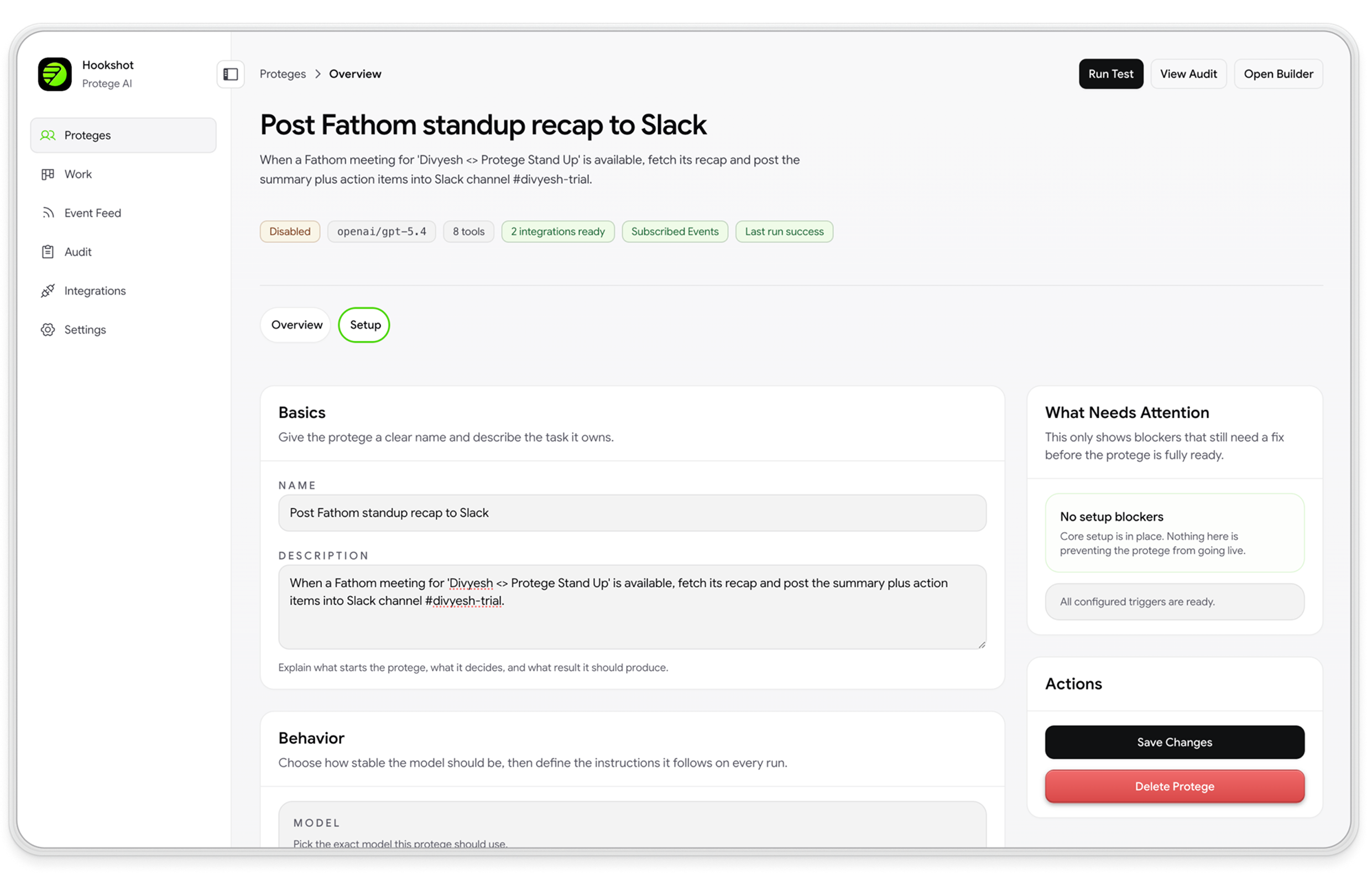
When cross-system work needs governed orchestration — not just sync — teams add a vendor-neutral layer on top of their existing ServiceNow deployment. Hookshot™ is built for that layer. Workhub is where ops teams run the Connect → Preview → Approve lifecycle on live queues.
Connect. Wire ServiceNow, Jira, Asana, Slack, and 1,000+ tools via MCP in one pass — no custom Spoke development for every downstream system.
Preview mode. The agent runs alongside live records and shows every action it would take with zero writes until your team approves — on a live ServiceNow case and the downstream Jira issue it would update.
Approve. Turn on writes under your rules. Low-risk updates flow through; high-risk actions stop for human review. Approval rules apply across every connected system.
Every run produces a step-by-step audit record across all connected systems — one timeline for PMO, Risk, and IT. Hookshot™ complements Now Assist and ServiceNow’s AI Control Tower roadmap; it does not replace ServiceNow as your ITSM system of record.
See Hookshot™ for the platform overview and Workhub for the Connect → Preview → Approve lifecycle.
Key takeaways
- ServiceNow is the system of record for enterprise ITSM — 8,800 customers and roughly 85% of the Fortune 500 (Q4 2025).
- Now Assist is licensed and metered — subscription plus per-usage tokens, uneven payoff by use case, and it stops at the ServiceNow boundary.
- Native integrations sync records, but spokes are often insufficient; custom REST is the norm when Integration Hub pricing or coverage falls short.
- Upgrade cycles are a standing ops tax on mature instances — six-month mandates, skipped records, and multi-week production freezes.
- Governed cross-SOR orchestration is what makes cross-tool automation safe enough for production — complementary to ServiceNow, not a replacement.
- Operational excellence needs a unified audit trail spanning your ticket system, dev queue, project tool, and chat — not separate logs per platform.
The bottom line
ServiceNow is the right foundation for enterprise IT operations. Now Assist speeds up in-platform work when data and use cases are right; Integration Hub keeps records aligned, but sync is not governance — it copies the record, not the approval trail. For work that crosses system-of-record boundaries — preview on a live downstream queue, approval by risk, one audit trail across every tool — plan for a governed orchestration layer alongside ServiceNow.
Start with clear, rules-based automation and fix knowledge-base and CMDB gaps before you scale AI. Add preview before writes. If your operations span multiple systems of record, book a demo or see ServiceNow vs. Hookshot™ for a detailed comparison.