Your platform team ships an incident-triage agent in AI Agent Studio. On Monday it classifies and routes correctly. On Tuesday, the same inputs produce a different plan. A tool that worked yesterday stops receiving parameters, and the playground returns a generic error with nothing useful in the execution logs. That pattern is documented across ServiceNow Community threads: agentic AI is non-deterministic, and inconsistent results can appear without any code change.
The incident closes in ServiceNow with an AI-drafted resolution note your team re-reads before trusting, plausible but wrong, the same pattern ServiceNow Community builders describe. ServiceNow ITSM earns a strong 4.5/5 across 1,800+ G2 reviews, yet the same reviewers flag AI output that must be read in full and recurring friction around complexity, cost, and the learning curve. Engineering never saw the ticket; their Jira epic still shows open. Slack still has the war-room thread from when the app team escalated. Risk asks one question nobody can answer from a single export: what ran, in what order, across which systems?
This is an orchestration problem. ServiceNow agentic AI did work inside the platform. The handoff to Jira, Workday, and Slack did not, and neither did the audit narrative across them. This article maps what ServiceNow’s native stack owns, where practitioners report uneven results, and where a vendor-neutral orchestration layer with preview and one run record still fits.
Agentic AI means AI that plans, chooses tools, and executes multi-step work toward a goal. It goes beyond summarizing a ticket or drafting a reply.
The shift from generative to agentic AI in ServiceNow
Generative AI inside ServiceNow answers questions and drafts content. Agentic AI goes further: it reads context, selects actions, chains steps, and writes back to records, often across more than one workflow before anyone reviews the outcome.
ServiceNow’s evolution tracks that shift. Now Assist stays assistive: summarize an incident, suggest a resolution, draft knowledge. ServiceNow AI agents move toward autonomy. Specialized agents coordinate through the AI Agent Orchestrator to fulfill a business objective end to end. The Workflow Data Fabric and Knowledge Graph ground those actions in enterprise data so agents are not guessing in a vacuum.
For IT operations leaders, the urgency is operational. When an agent can close a case, reassign a group, or trigger an Integration Hub spoke, you need to prove what it did across every system it touched and pause it in minutes if it drifts.
The Yokohama release introduced AI Agent Studio and AI Agent Orchestrator as the native build-and-coordinate stack for platform-internal agentic workflows. That is a credible starting point inside ITSM. Enterprise-wide automation is a longer road.
Inside the ServiceNow AI Agent Studio and Orchestrator
ServiceNow’s native agentic toolkit is real and improving, but buyer evaluations should separate what the platform ships from what practitioners reliably get in production. IT architects evaluating servicenow ai agent studio and servicenow ai agent orchestrator need a clear map of what each layer owns and where multi-tool stacks still split ownership.
AI Agent Studio is the build console, not a magic “describe it in English” switch. You define an agent’s role, goal, and instructions in natural language, then wire deterministic tools the agent invokes at runtime: Flow Designer flows, scripts, Now Assist skills, and Integration Hub actions. ServiceNow’s own guidance frames this as a hybrid (LLM reasoning on top of tools you still build, test, and scope), which is why clear use-case boundaries and supervised modes matter for consequential ITSM paths. Teams test, activate, and monitor agents from the same console; recent releases add MCP Server Console capabilities for publishing governed tool endpoints.
AI Agent Orchestrator coordinates multi-agent handoffs inside the platform: incident triage, change coordination, HR case routing. For ITSM-centric workflows, that orchestration stays in the system of record where IT already lives.
Integration Hub extends reach through spokes and REST actions so agents can call external APIs. Calling an external API and governed cross-system orchestration with one audit timeline are different jobs.
At Knowledge 2026 (May 2026), ServiceNow expanded the stack further. AI Agent Fabric supports Model Context Protocol (MCP) and Agent2Agent (A2A). A2A has been available since the Zurich line. ServiceNow agents can interoperate with external agents and expose platform capabilities to outside orchestrators. Action Fabric opens ServiceNow’s full system of action (flows, playbooks, approvals, catalogs) to any AI agent through a generally available MCP Server, with actions running through Control Tower for identity, permissions, and audit. AI Control Tower now targets discover / observe / govern / secure / measure across 30+ enterprise integrations, with real-time agent observability (including Traceloop) and a kill switch for agents that operate beyond assigned permissions (Veza integration). Many Control Tower enhancements are rolling out through Innovation Lab now, with GA expected August 2026. Worth tracking if your evaluation timeline is this quarter.
ServiceNow’s stated ambition, in Amit Zavery’s words at Knowledge 2026, is a single location to orchestrate agents and prevent sprawl. That is directionally coherent for a ServiceNow-centric estate. The buyer question is whether that control plane also satisfies teams whose systems of record for engineering, HR, and customer ops live in Jira, Workday, and Slack, and who need preview on live work before writes with a single run record Risk can export without reconciling three dashboards.
What production looks like: uneven wins and a real data tax
Analyst surveys and marketing paint a confident arc. Community threads and independent reviews tell a messier story.
Gartner predicts that over 40% of agentic AI projects will be canceled by the end of 2027, citing escalating costs, unclear business value, or inadequate risk controls (Gartner, June 2025). Dynatrace’s Pulse of Agentic AI 2026 survey of 919 senior global leaders finds enterprises stalling because they cannot yet govern, validate, or safely scale autonomous systems. Bain’s Automation and AI Pathfinder Survey 2026 (951 global companies) reports 38% on “human approval required” as the dominant operating model; only 7% run fully autonomous agents in production.
Inside ServiceNow specifically, community builders report hallucinated workflow outputs with no direct retraining loop. You refine instructions and grounding data, not the underlying model. Suggested resolutions can be plausible but wrong; teams re-read every AI draft before trusting it, which eats the time savings. Assist consumption is hard to forecast once adoption scales. In one ServiceNow Community thread on deflection tracking, an admin reports that even after working through the question with ServiceNow HI Support and the Now Assist product team, LLM-based Virtual Agent flows make deflection difficult to track accurately, so headline deflection numbers are hard to verify in practice. On G2, the platform’s 4.5/5 rating across 1,800+ reviews reflects genuine enterprise satisfaction, but criticism clusters on complexity, cost, and the learning curve. ServiceNow practitioners put the data-hygiene point plainly: Now Assist is only as good as the KB and CMDB underneath it; stale records produce confident-but-wrong output.
The wins are real when the foundation is clean. In ServiceNow’s published EY case study, an AI agent handles roughly 12,000 actions per day and drafts resolution notes for a human to approve before closing the ticket. Raleigh reported roughly 98% summary acceptance after tightening knowledge-base hygiene. Value tracks with CMDB and KB quality, human review on consequential writes, and visibility into what each run actually consumed.
ServiceNow ships meaningful governance inside the platform: Studio, Orchestrator, Fabric, Action Fabric, and Control Tower. The orchestration gap shows up when the same run must write outside ServiceNow and no one dashboard tells the full story.
Orchestrating across the enterprise: beyond the ServiceNow silo
ServiceNow is the bedrock for IT operations in most large enterprises. See ServiceNow integrations for how teams connect it into the stack. It is rarely the only system of record.
Engineering lives in Jira. HR runs on Workday. Intake and escalation happen in Slack. Customer context sits in CRM. Cross-system handoffs are universal. What most teams run today is deterministic integration: bi-directional ServiceNow–Jira sync, Slack war rooms on P1/P2 incidents, tier-one deflection bots in Slack before a ticket opens. Integration vendors and ITSM-in-Slack guides have documented these patterns for years. Agentic orchestration across vendors is still emerging. Cognizant’s Neuro AI Multi-Agent Accelerator registered ServiceNow agents alongside third-party and homegrown agents in June 2026, but that is early adopter territory, not what most ITSM teams run on day one.
Even the sync that “works” carries a failure mode the vendor docs rarely name. Connect two event-driven platforms bi-directionally without origin awareness and each one can read an integration-driven update as a fresh human change. A Resolved incident flips back to In Progress, a closed Jira issue reopens overnight, and the ticket history fills with updates nobody triggered. It seldom throws an error. As integration engineers document, it runs silently and corrupts the SLA records and audit trail you would later need to reconstruct what happened. Loop prevention (integration-user filtering, origin tagging) is well understood and lives in the sync layer. Point-to-point sync leaves each system with its own log, so reassembling one chronological narrative across tools stays manual.
MuleSoft’s 2026 Connectivity Benchmark (1,050 IT leaders) finds the average enterprise runs 957 applications with only 27% connected, and half of AI agents still operate in silos. Integration strategy and orchestration design matter as much as agent building.
servicenow integration hub spokes, Action Fabric, and AI Agent Fabric help here, but buyer architecture still splits. Fabric and MCP let external orchestrators invoke ServiceNow capabilities; Control Tower governs AI assets across vendors. What multi-tool operations teams still ask for is a neutral layer that treats ServiceNow as one connector among several, enforces preview before downstream writes, and produces one audit timeline HR, IT, and Risk review together.
| Dimension | ServiceNow-centric orchestration | Vendor-neutral cross-SOR orchestration |
|---|---|---|
| Primary control plane | AI Agent Orchestrator + Control Tower inside the platform | External workspace that connects ServiceNow + adjacent SORs as peers |
| Agent build surface | AI Agent Studio (strong for ITSM-native agents) | Complements Studio for cross-tool agents and event-driven triggers |
| Cross-system writes | Integration Hub spokes + Fabric / Action Fabric (MCP/A2A) | Preview on live work in each target system before write-back |
| Audit narrative | Platform logs + Control Tower inventory | One chronological run record across every tool call on a workflow |
| Lock-in posture | Deepens value inside ServiceNow estate | Keeps AI logic portable across vendor boundaries |
When your compare exercise needs a side-by-side on preview, audit, and cross-tool orchestration, see ServiceNow vs Hookshot™.
Preview, approval, and audit: orchestration requirements, not afterthoughts
Scaling agentic workflows across systems means baking three capabilities into the orchestration layer, not bolting them on after an incident:
Preview on live work. Studio testing validates behavior in a builder sandbox. Production needs preview alongside live queue work: every action the agent would take, with zero writes until your team approves. That matches how teams actually operate. Dynatrace reports 69% of agentic AI decisions still verified by humans and 87% of organizations deploying agents that require human supervision; only 13% rely on fully autonomous agents today. If fulfillers must re-read every AI-generated resolution note before trusting it, preview and approval gates keep the review step visible instead of buried in queue work.
Approval rules by risk tier. Read-only triage can automate sooner. CMDB updates, change approvals, and cross-system write-backs stay behind explicit human gates, the pattern 38% of Bain respondents already call their dominant model.
One tamper-resistant run record. KPMG’s AI Quarterly Pulse Survey, Q1 2026 finds 64% of technology-sector organizations have identified high-risk use cases where autonomous agent decision-making is not allowed; 62% do not allow agents to access sensitive data without human oversight. Control Tower and platform logging give IT strong visibility inside ServiceNow. When the same run also updates a Jira epic and posts to Slack, native logs alone may not capture the full cross-system context in one immutable narrative. When a sync loop has been quietly rewriting state, those separate logs may not even agree with each other. A vendor-neutral agent run record lets Risk replay the full run without reconciling three exports.
Introducing Hookshot™: the orchestration layer for agentic workflows
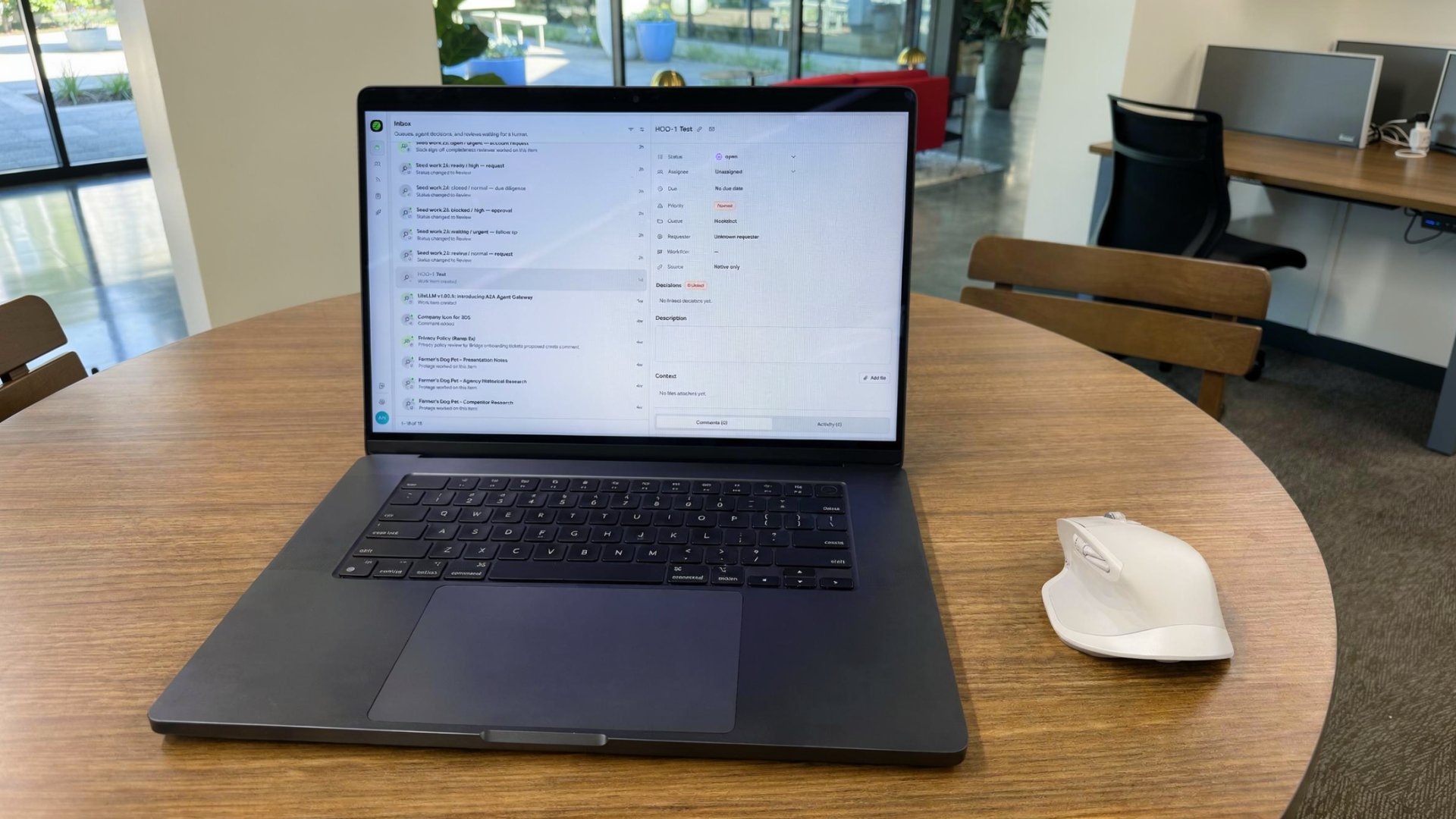
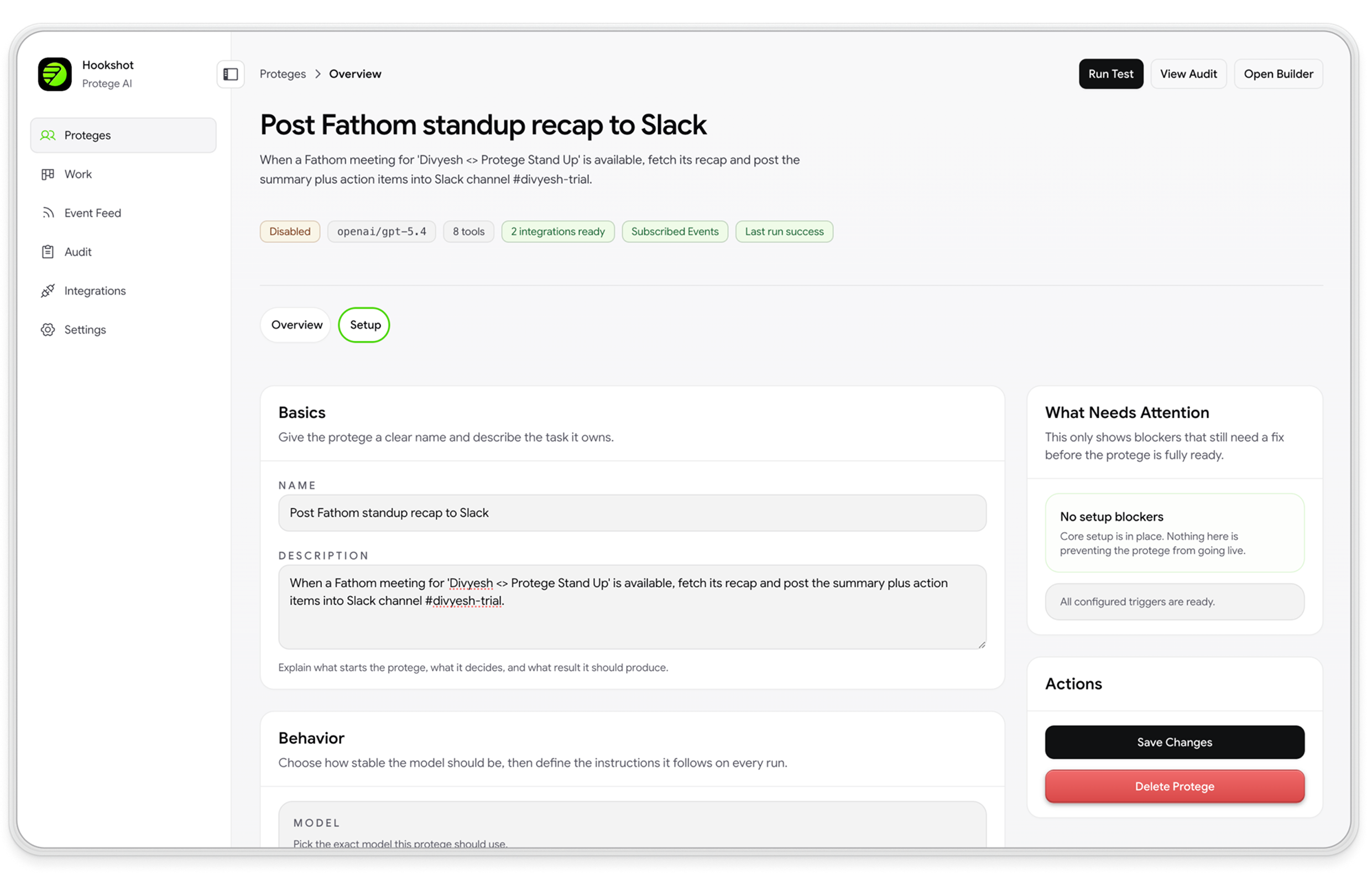
Hookshot™ is the orchestration layer for teams that already run ServiceNow and need agents to operate safely across the rest of the stack, with preview, approval rules, and one audit timeline built in from the start.
Event-driven triggers. Agents respond to what happened in production (ticket opened, SLA breached, deal stage changed), not only to in-platform field changes or schedules.
Multi-tool integrations. Connect your tools into one event feed: ServiceNow cases, Jira issues, Workday records, Slack threads. ServiceNow stays the ITSM system of record. Hookshot™ does not replace AI Agent Studio for platform-native agents.
Hookshot™ complements ServiceNow’s agentic stack with a unified command center for governed cross-SOR deployment:
- Build. Scope integrations, data boundaries, and approval rules before an agent touches production.
- Operate. Connect systems, learn from how work resolves in your queues, watch agent streams in preview mode, approve writes when your rules say the risk profile is acceptable.
- Govern. Every run produces a tamper-resistant record: triggers, tool calls, skips, human approvals, and outcomes.
That lifecycle (connect → learn → watch → approve → automate) is how IT leaders move from pilot to production without betting the queue on day one. For ticket-heavy teams, Workhub applies the same pattern to ServiceNow, Jira, and Workday queues specifically: preview on live tickets, approval gates, full run history.
Event-driven workflow automation on Hookshot™ treats ServiceNow as one connector in a governed stack. When platform engineering owns Studio and IT operations owns cross-team handoffs, Hookshot™ is the layer that keeps both honest: one timeline neither side has to re-derive from separate vendor dashboards.
Key takeaways for IT leaders
Distill this for your architecture review or vendor evaluation:
- AI Agent Studio and AI Agent Orchestrator are the starting point for platform-native servicenow ai agents: natural-language agent design wired to deterministic tools you still build and scope.
- Action Fabric, AI Agent Fabric, and AI Control Tower extend reach and governance inside and across vendor AI estates. They do not replace vendor-neutral orchestration when other teams’ systems of record sit outside ServiceNow.
- Cross-system handoffs are solved today with sync and deflection. Agentic orchestration across SORs is still emerging. Architecture should match that timeline. Preview, approval rules, and one run record are how you scale safely when write-backs cross tool boundaries.
- Hookshot™ provides the orchestration infrastructure to connect ServiceNow with Jira, Workday, Slack, and the rest of the stack: event-driven triggers, preview on live work, and one audit timeline Risk can export.
Conclusion: deploying your first orchestrated agent
Start with a low-risk, high-visibility ITSM use case inside ServiceNow (triage suggestions, routing recommendations, read-only enrichment) where stakeholders can see value in days, not quarters. Keep human review on every consequential write, the way EY and other published customers operate.
Define what matters before you expand cross-system: which records the agent may read, which downstream SORs it may write to, who owns the kill switch, and what evidence satisfies your next audit. Ship cross-SOR paths in preview mode first. Turn on write-back only when your team has watched enough runs to trust the pattern.
ServiceNow’s Action Fabric and MCP Server make a complement layer a natural fit alongside Studio. Platform engineering keeps Studio for ITSM-native agents. Operations teams add Hookshot™ where cross-SOR orchestration, preview on live work, and one audit timeline are the acceptance criteria.
Your next steps:
- Map your highest-friction ITSM workflows. Where do handoffs stop at ServiceNow’s edge?
- Score each candidate by risk: read-only vs. write-back, internal vs. customer data, single-system vs. cross-SOR.
- Inventory what Studio, Fabric, Action Fabric, and Control Tower already cover, and where you need neutral orchestration with preview and per-run audit.
- Book a walkthrough of orchestrated agent workflows on Hookshot™: preview mode, approval gates, and exportable audit trails. Read Introducing Hookshot™ for the platform architecture, and Why Asana AI Needs a Governance Layer for the same cross-stack pattern in PMO contexts.
Servicenow agentic ai scales when orchestration matches how your organization actually works: one ITSM system of record, several adjacent systems of record, and one timeline your IT, Risk, and engineering teams can stand behind together.
Frequently asked questions
What is ServiceNow AI Agent Studio?
AI Agent Studio is ServiceNow's build console for agentic workflows and AI agents. You define an agent's role, goal, and instructions in natural language, then wire deterministic tools it can call: Flow Designer flows, scripts, Now Assist skills, and Integration Hub actions. It is not drag-and-drop workflow design. The LLM reasons toward a goal and invokes tools you still build and scope.
What is the difference between Now Assist and ServiceNow AI agents?
Now Assist is assistive Gen AI: summarize incidents, draft replies, suggest resolutions. ServiceNow AI agents are agentic. They plan, choose tools, chain steps, and can write back to records. Community guidance distinguishes supervised agents (human approval before consequential actions) from fully autonomous ones; most production deployments lean supervised for ITSM work.
Can ServiceNow AI agents act across Jira, Slack, and Workday?
Not on their own. ServiceNow AI agents act natively inside ServiceNow; to reach Jira, Slack, or Workday they call out through Integration Hub spokes or third-party integration tools. In practice that is mostly deterministic sync today (moving records, notifications, and status), not one agent autonomously operating across all three. ServiceNow's MCP Server and Agent2Agent (A2A) support let its agents interoperate with other agents and orchestrators, but those are agent-interoperability protocols, not native connectors to Jira, Slack, or Workday. Acting across every system with preview before writes and one audit timeline is where a vendor-neutral orchestration layer fits.
Is a ServiceNow-Slack or ServiceNow-Jira integration enough to govern AI agents across systems?
For many teams, no. The native ServiceNow for Slack app and bi-directional Jira sync move records, notifications, and status between tools, which is why incident-to-engineering handoffs are common. Point-to-point integrations do not produce one auditable, replayable record of what an agent decided, skipped, and wrote across systems: the Slack thread, ServiceNow incident, and Jira issue stay separate logs. War-room automation and a unified timeline are usually add-ons (specific modules or third-party iPaaS), not defaults. An orchestration layer adds preview before downstream writes and one cross-system run record on top of those integrations.
What is the bidirectional update loop in a ServiceNow-Jira integration?
When two event-driven platforms sync both ways without origin awareness, each system can read an integration-driven update as a fresh human change. A Resolved incident flips back to In Progress, a closed Jira issue reopens, and ticket histories fill with updates nobody triggered. It rarely throws an error. It runs silently and corrupts the SLA records and audit trail you would later need. Loop prevention (integration-user filtering, origin tagging) is well understood and lives in the sync layer. Reconstructing one chronological record of what an agent did across ServiceNow, Jira, and Slack is a separate job an orchestration layer handles with a single run record.
Where does vendor-neutral orchestration still matter if ServiceNow has AI Control Tower?
Control Tower governs AI assets across vendors inside ServiceNow's program: discovery, observability, policy, and (with recent releases) a kill switch for off-script agents. That is strong for platform and enterprise AI inventory. The gap shows up on cross-SOR runs. When the same workflow updates a ServiceNow incident, a Jira epic, and a Slack thread, teams still need preview on live work in each target system and one chronological run record Risk can export without reconciling separate vendor dashboards.
When should IT add an orchestration layer on top of ServiceNow agentic AI?
When handoffs stop at ServiceNow's edge. Engineering's system of record is Jira, HR lives in Workday, intake happens in Slack, and you need event-driven triggers, preview before downstream writes, and approval rules by risk tier with a single audit timeline across every tool touched. Start with read-only triage inside ServiceNow; add neutral orchestration when cross-SOR write-backs become part of the acceptance criteria.